Project Name
Sigma Detection Lab: Authoring and Validating Sigma Rules Against Real Telemetry
One-line Summary
I wrote a Sigma rule for Linux account discovery, converted it into a backend query with sigma-cli, and followed it all the way through a home lab pipeline (auditd, Filebeat, Wazuh) until it actually fired on real telemetry.
Full Description
Writing Sigma YAML on its own doesn't prove much. What I wanted was the full loop. Pick an ATT&CK technique, produce the real behaviour on a Linux host, write the rule against the fields the logs actually contain, convert it with pySigma, and then confirm it in a SIEM. That last step is where detection engineering either holds up or falls apart, so it's the part I cared about most.
I used an Ubuntu VM as the monitored host and ran auditd on it for kernel level audit logging. For the SIEM I began with a local Elastic Stack (start-local) and Filebeat, then moved over to Wazuh once that first setup started fighting me. Wazuh was already built for auditd and came with MITRE ATT&CK mapping out of the box, so it fit the goal better.
Lab Architecture
- Ubuntu VM: the monitored Linux host producing auditd telemetry
- auditd: kernel level audit logging for file access and syscalls
- Wazuh (manager, indexer, dashboard): the SIEM backend handling log collection, rule based alerting, and MITRE mapping
- Filebeat OSS 7.10.2: ships alerts from the Wazuh manager into the indexer
- sigma-cli and pySigma: converts vendor neutral Sigma rules into backend queries
The Detection-Engineering Loop
- Pick a technique from MITRE ATT&CK that fits a Linux host
- Produce the behaviour on the lab host and confirm auditd really records it
- Write the Sigma rule against the field structure the logs actually show
- Convert the rule into a backend query with
sigma-cli - Validate by running the query, watching it fire, and tuning out the false positives
Detection 1: Sensitive File Access on /etc/passwd
/etc/passwd holds every local user account: the name, UID, home directory, and shell. Once an attacker has a foothold, reading this file is a common way to list accounts and pick out privileged users before moving laterally or escalating. It maps to T1087.001, Account Discovery: Local Account.
An auditd watch rule tags any access to the file with the key passwd_watch:
A plain read is enough to trigger it:
Detection Logic
detection:
    selection:
        auditd.log.key: 'passwd_watch'
    filter_config_change:
        auditd.log.record_type: 'CONFIG_CHANGE'
    condition: selection and not filter_config_change
The rule matches events tagged passwd_watch but throws out CONFIG_CHANGE events. That exclusion is where the interesting part of this project actually began.
Why the False-Positive Filter Exists
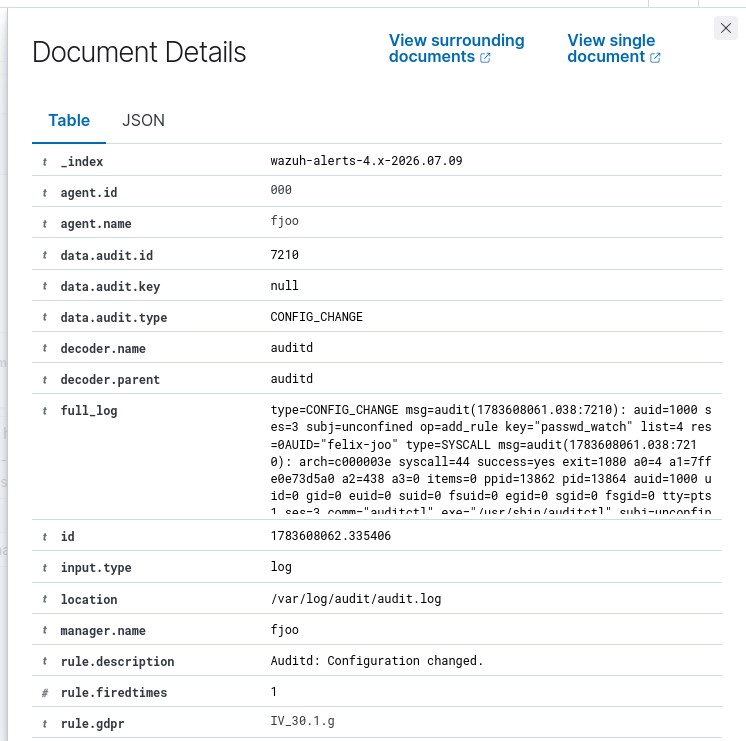
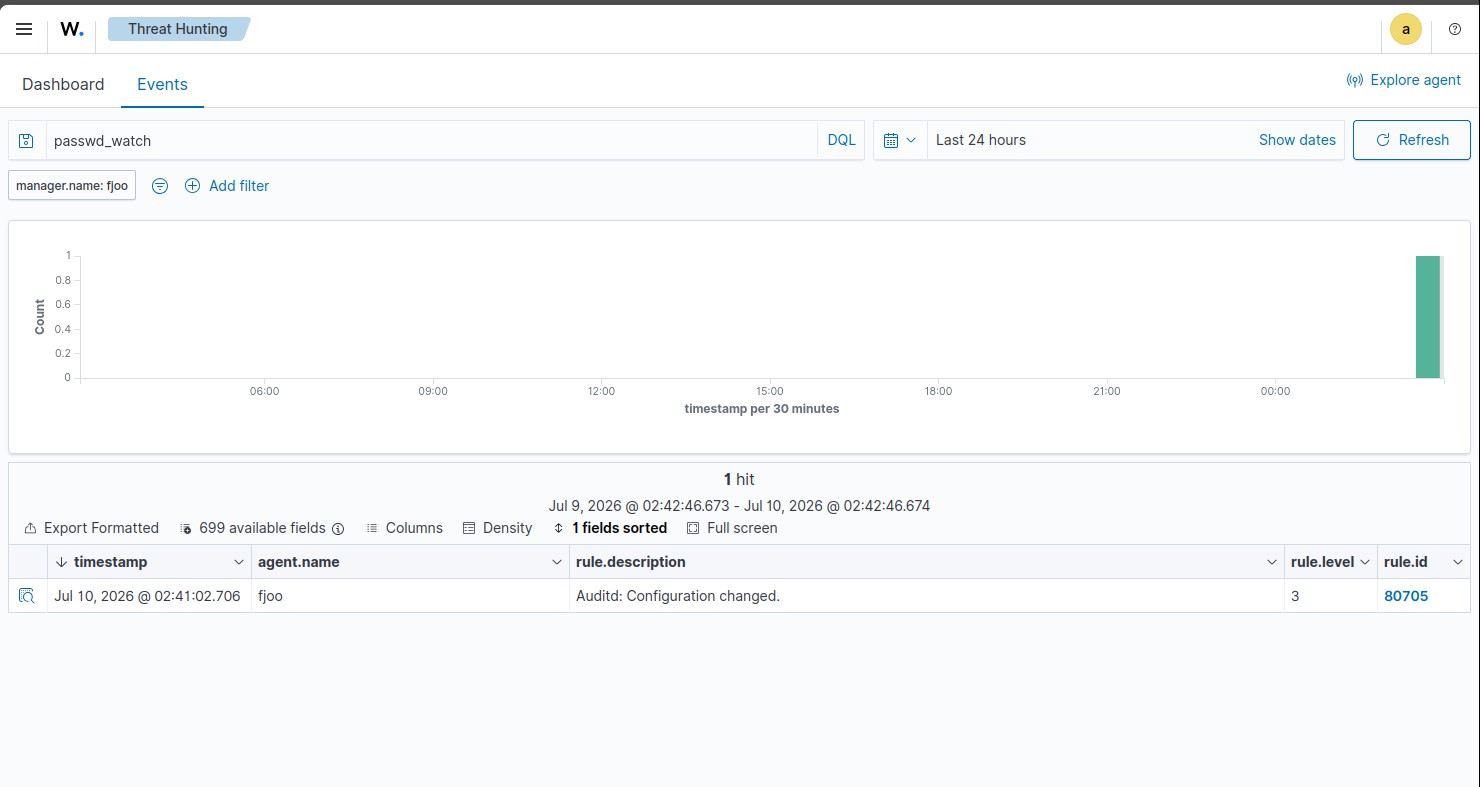
My first version of the rule used nothing but auditd.log.key: passwd_watch. It returned events in testing, which looked like success until I opened them up. They were CONFIG_CHANGE and op=add_rule records: auditd logging the moment the watch rule was created and removed, purely because the string passwd_watch lives inside the rule definition. None of them were file access.
That turned out to be the real lesson of the whole project. Getting results back from a search is not the same as detecting the behaviour you meant to catch. The filter_config_change clause strips that noise out so the rule reflects someone actually touching the file rather than me editing audit rules.
The false positives worth expecting in production:
- Admins manually checking accounts
- Backup or config management tooling reading the file
- Login processes reading it during normal operation
Conversion
Converted with sigma-cli against the Lucene backend:
The filter carries straight through into the final query:
Detection Summary
| Field | Value |
|---|---|
| Technique | T1087.001, Account Discovery |
| Log Source | linux/auditd |
| Detection Key | passwd_watch |
| Backend | Lucene (Wazuh / Elasticsearch) |
| Status | Experimental |
Pipeline: Getting Telemetry to Actually Flow
Writing the rule was the quick part. The worst bug in this project had nothing to do with detection logic at all. It was a Filebeat version mismatch. The Wazuh indexer runs on OpenSearch and expects Filebeat OSS 7.10.2, but Filebeat had already been bumped to 9.x during the earlier Elastic Stack work. The newer Filebeat looked at the indexer, decided it wasn't a compatible Elasticsearch, and quietly refused to index anything, all while /var/ossec/logs/alerts/alerts.log kept filling up on the manager side. So the manager was clearly working, yet the dashboard stayed empty.
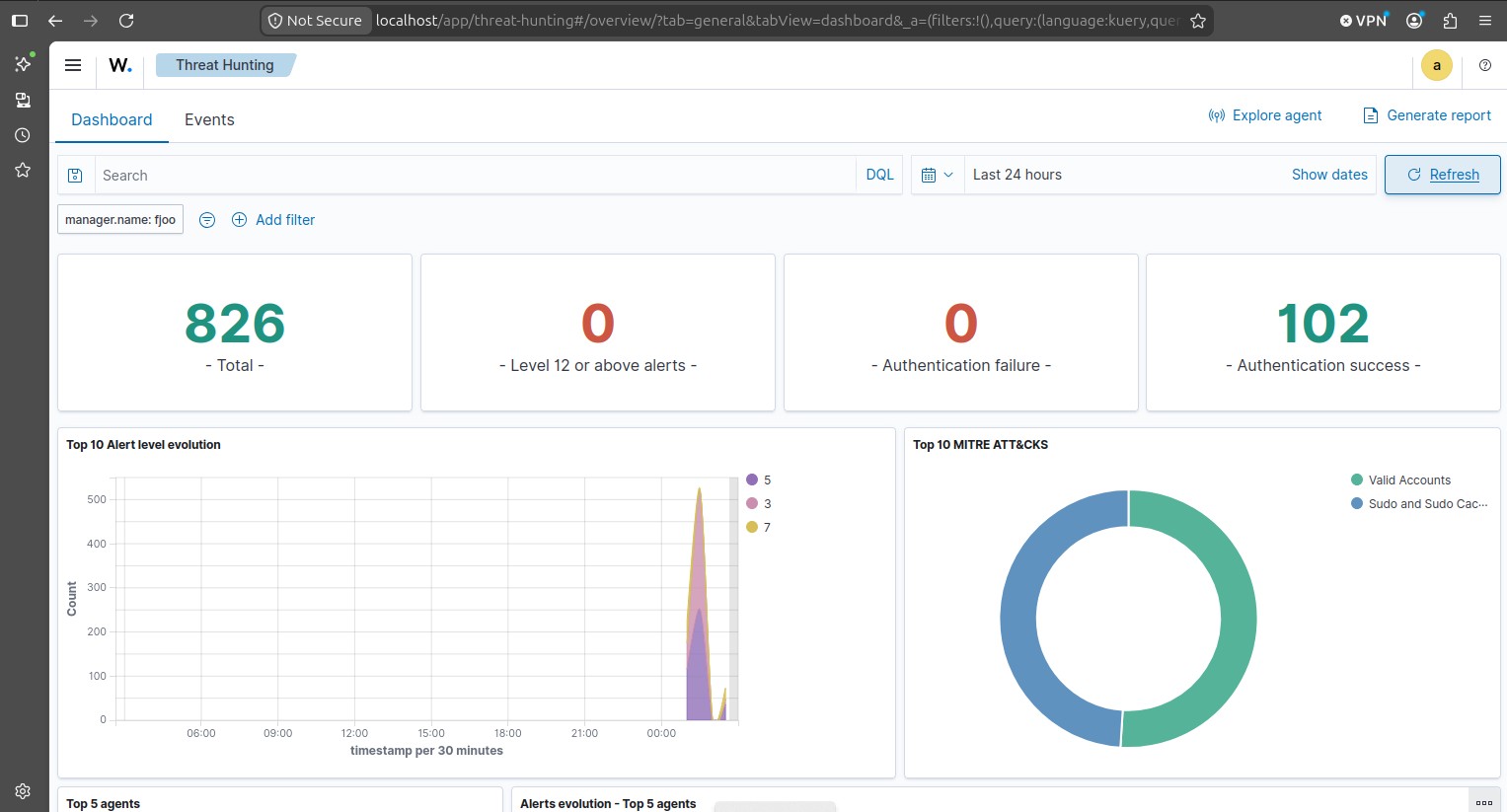
I found it by reading the shipper logs and following the _license and unexpected build flavor errors back to their cause. The fix was to remove Filebeat 9.x, install filebeat 7.10.2-1 from the Wazuh APT repo, and reapply the Wazuh config with the right host, TLS certs, and admin credentials. Alerts began flowing the moment it restarted, and the MITRE ATT&CK panel filled in with real hits (Sudo mapping to T1548, plus Valid Accounts).
Key Lessons
- A search hit is not a detection. Telling apart "something matched" from "the behaviour I meant to catch was actually caught" is the core skill here, and it's what forced the
record_typefilter above. - Telemetry choice matters. auditd file watches (
-w) turned out noisy and unreliable for read access on this kernel. Auditing execve and openat is cleaner and gives you far more to work with for command execution detections. - Pipelines break in the boring middle. Version compatibility between the shipper and the indexer is not something you can skip. An OpenSearch backed SIEM needs a matching OSS shipper, and that gap is exactly where this build fell over.
Known Limitations
On this test kernel (Ubuntu 26.04, kernel 7.x), auditd read auditing through -w was unreliable. Read syscalls often went unrecorded even though the watch rule's own CONFIG_CHANGE events came through fine. A later revision of this detection will watch the openat syscall on /etc/passwd directly instead, which should hold up better.
Tools & Technologies Used
- Sigma / SigmaHQ
- pySigma and sigma-cli
- auditd
- Wazuh (Manager, Indexer, Dashboard)
- Filebeat OSS 7.10.2
- Elastic Stack (start-local)
- MITRE ATT&CK
- Ubuntu Server
Key Skills Demonstrated
- Writing Sigma rules against real telemetry
- False positive tuning and detection precision
- MITRE ATT&CK mapping
- Log pipeline architecture and troubleshooting
- Converting detections into SIEM backend queries with pySigma
- Working with Linux audit telemetry (auditd)
- Root cause diagnosis from shipper and indexer logs
- Detection validation methodology
The rule itself comes down to a handful of lines of YAML. The real work was making it mean something, so it matched genuine behaviour instead of my own rule editing, and getting it to travel cleanly through a pipeline that kept breaking in unglamorous places.
View on GitHub